
 Back
Back


The AWS Outage Just Changed What Enterprises Expect From Their Cloud Provider
The recent AWS disruption didn’t just affect enterprises running their own infrastructure but instead it affected your enterprise clients, those who really trust you to keep their services running.
And now they’re asking questions:
- “Can you provide failover to another cloud provider?”
- “What’s your multi-cloud disaster recovery plan?”
- “Why are we still dependent on a single vendor?”
If you’re a cloud service provider (CSP) still offering single-cloud managed services, this moment is either your biggest opportunity or your biggest vulnerability.
Why enterprises now demand multi-cloud from their CSP
Barely five years ago, enterprises wanted you to manage their AWS environment. Today, cloud independence is what they desire and what you are expected to provide.
What changed:
- Vendor risk is board-level concern – Multiple hyperscale outages made single-cloud dependency unacceptable
- Regulatory requirements – APAC data sovereignty laws require hybrid solutions mixing on-prem and public cloud
- Best-of-breed architecture – Enterprises want AWS for compute, Azure for Microsoft integration, GCP for analytics—managed by one provider
- Your competitors are already selling it – Other CSPs are pitching “cloud-agnostic managed services” to your clients
The question isn’t whether to offer multi-cloud services. It’s whether you can deliver them profitably.
Why multi-cloud kills your margins (without the right platform)
Managing one client across three clouds is complex. Managing 50 clients across three clouds can be chaotic.
Without proper tooling, multi-cloud means:
- Separate consoles per cloud per client—engineers toggling between dozens of dashboards
- Manual cost aggregation—reconciling AWS, Azure, and GCP bills eats margin through errors and labor
- Inconsistent access controls—each cloud has different IAM, creating security gaps
- No unified SLA monitoring—you can’t prove service quality when telemetry is scattered
- Complex resource allocation—how do you isolate Client A’s dev quota from Client B’s production?
Multi-cloud services should command premium pricing, but operational overhead eats into your revenue.
How one Hong Kong CSP made multi-cloud profitable
IDCServices.net Inc faced this exact problem. As client demand for deployments across AWS, GCP, and Azure accelerated, their operational model broke down.
Their pain points:
- Each platform required separate interfaces and user management
- Manual usage tracking was time-consuming and error-prone
- No unified view meant juggling credentials constantly
- Billing across three clouds made real-time cost tracking impossible
- Consolidated client invoices required painful manual reconciliation
What was supposed to be a revenue opportunity turned out to be an administrative nightmare.
The solution: Purpose-built multi-tenant platform
After implementing MQloud, IDCServices.net has transformed their operations:
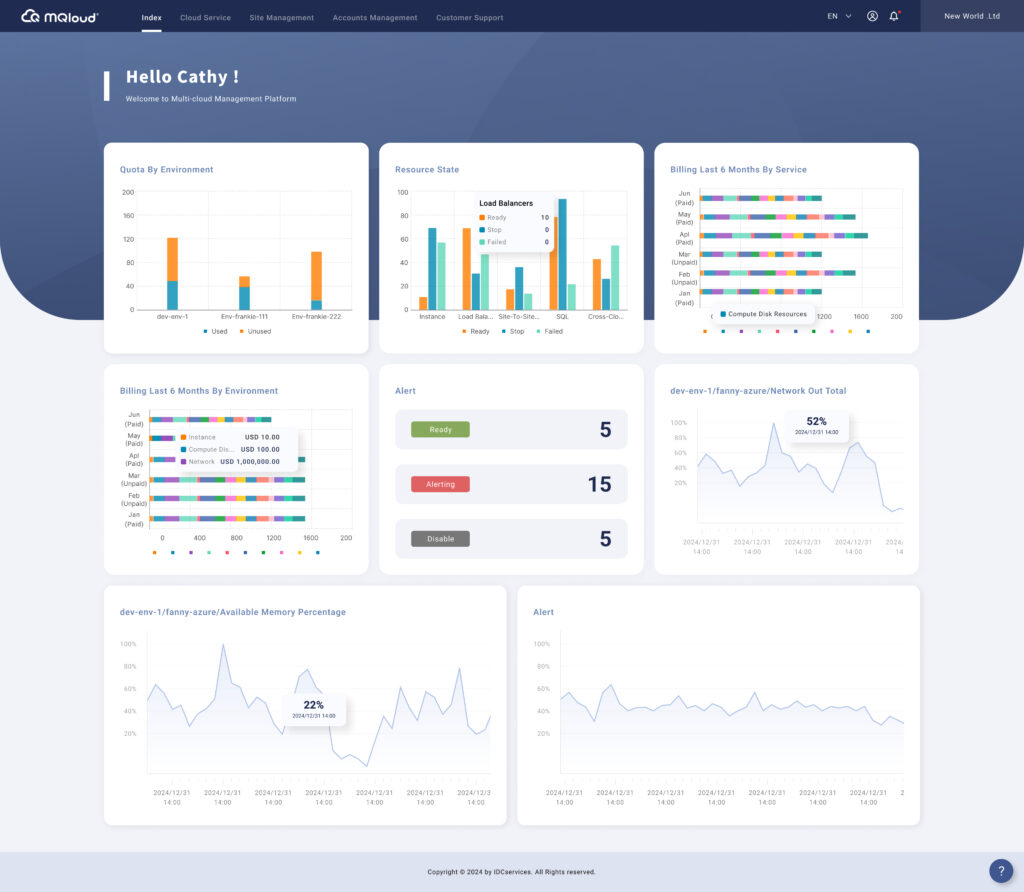
- One interface managing AWS, GCP, and Azure with client isolation
- Project-based permissions per client, workload, and environment without manual overhead
- Automated cost visibility consolidated across providers for accurate client billing
- Faster provisioning through centralized dashboard and networking
- Regional compliance with firewall controls and data residency enforcement
- Client transparency with direct visibility into their own consumption
- Result: They now win enterprise deals single-cloud competitors can’t service—and deliver them profitably
The AWS outage is your sales opportunity
Right now, your clients are asking: “Should we find a provider who already offers multi-cloud resilience?”
Proactive outreach script:
“Following the recent AWS incident, we wanted to share how [Your Company] ensures no single provider outage impacts your services. We’ve built multi-cloud management capabilities specifically for situations like this. Would a brief architecture review be valuable?”
But only if your operations can actually deliver on this promise.
What you need to make multi-cloud work
Your platform must provide:
- Multi-tenant architecture – True client isolation with delegated access and separate billing
- Cross-cloud standardization – Consistent provisioning and governance across providers
- Unified observability – One dashboard for all clouds and clients with SLA-focused alerting
- Automated cost allocation – Real-time per-client, per-cloud spending for margin protection
- Client-facing portals – White-label dashboards clients can access directly
Move first or lose ground
The AWS outage exposed what enterprises need: multi-cloud resilience they can’t build themselves.
CSPs who act now will:
- Win deals competitors can’t touch
- Command premium pricing for differentiated services
- Protect relationships from hyperscaler direct sales
CSPs who wait will:
- Lose clients to “cloud-agnostic” providers
- Get squeezed into low-margin single-cloud reselling
- Watch enterprises bypass them entirely
See how CSPs across APAC deliver profitable multi-cloud services
MQloud is purpose-built for service providers managing multiple clients across multiple clouds. IDCServices.net is using it to turn operational chaos into competitive advantage.
- Ready to explore how it works for your business? Contact US
- Want to see the full IDCServices.net story first? Read the case study
